


The Wisconsin Constitution: Initial Adoption Fights and a Veto Power That’s Still Contested
The charter is a guide for safeguarding the state’s aim of self-determination.
This essay is part of a 50-state series about the nation’s constitutions. We’ve asked an expert from each state to dive into their constitution, narrate its history, identify its quirks, and summarize its most essential components for our readers.
In 1848, voters in the Wisconsin Territory ratified the Wisconsin Constitution that is still in use today. This founding document, amended more than 150 times, reflects the work of generations of legislators, advocates, and voters on topics from democracy to finance to individual rights.
A Tale of Two Constitutions
The Wisconsin Territory was established in 1836, following the U.S. government’s forced removal of Native Americans from their land. Settlers then occupied the territory and Wisconsin quickly qualified for statehood. Territorial voters, however, rejected statehood referenda in 1842, 1843, and 1845 before finally approving one in 1846.
Two months after Congress passed the enabling act that granted permission for the territory to transition to statehood, 124 delegates to the Wisconsin constitutional convention met in Madison. The act and the Northwest Ordinance set some of the non-negotiable terms of the constitution, including prohibiting slavery, dedicating land for public schools and universities, and requiring voter approval of the proposed constitution. While this saved the Wisconsin delegates from some of the more contentious debates that took place in other states, they still had heated debates of their own.
The 1846 convention drafted a proposed constitution that would have banned banking, allowed white immigrants who applied for citizenship to vote, granted married women the right to own property, and simultaneously put Black suffrage to a popular referendum. Each of these provisions drew controversy and vigorous opposition. In particular, delegates debated the contents of the suffrage article for several days, during which abolitionist delegates clashed with those opposing Black suffrage.
When the proposed constitution went before voters, the electorate rejected it, as well as the Black suffrage referendum. The voting population, then only white men, harbored concerns about giving voting rights to Black men and property rights to married women. And the commercial banking prohibition, intended to stymie powerful banks that could bribe legislators, drew opposition from banking interests.
The 1847 constitutional convention met with these concerns in mind. Its drafters omitted women’s property rights. They also authorized the legislature to establish commercial banking and extend the franchise to Black men, but only if the legislature gained approval through a popular referendum. Voters approved this version of the constitution in March 1848. In 1849, they approved a referendum allowing Black men to vote (though it did not immediately take effect due to a dispute over the number of votes required to approve a referendum), and, in 1851, authorized the legislature to grant bank charters or pass general banking laws, each of which would be subject to a further referendum vote.
Unique Rights
Immediately after the Preamble, the Wisconsin Constitution begins with the Declaration of Rights. Since the state’s inception, the Declaration of Rights has included a mix of rights analogous to those in the federal Constitution, rights that are broader versions of those in the federal Constitution, and ones with no federal analog. Voters have also amended the constitution to expand rights over the years. For example, the Declaration of Rights begins with a provision that speaks to equality and inherent rights, and also includes a right to a remedy in the law; a right to fish, hunt, trap, and take game; and a right to bear arms.
Rights are also protected in other articles. For example, a section of the education article guarantees the right to a free uniform system of public education. Similarly, a section of the article on suffrage provides the right to vote, which has become more inclusive over time. In 1882, an amendment removed racial exclusions from the state constitutional right to vote, and a 1934 amendment formally eliminated the male-only voting restriction, more than a decade after women had gained the right to vote under the U.S. Constitution under the 19th Amendment (which Wisconsin was the first state to ratify). Other amendments have removed categorical prohibitions against voting by individuals “under guardianship” or “convicted of treason or felony . . . unless restored to civil rights.”
Unified, Elected Judiciary
The constitution also provides for the organization of the state court system, which voters overhauled through a series of amendments in 1977. The substance of the amendments can be traced back to a 1950 Wisconsin Law Review article by Wisconsin’s then-Attorney General Thomas E. Fairchild, who proposed improving judicial administration by replacing the state’s ad hoc courts with a unified judiciary of plenary jurisdiction. The 1977 amendments created a single court of appeals, established a system of courts with standardized jurisdictions, and gave the state supreme court superintending and administrative authority over the entire judiciary. These changes remain the organizational foundation of the state’s judiciary today.
Wisconsin has elected its judges since the constitution’s adoption. Five circuit court judges, who also served as the members of the supreme court for the first five years of the state’s history, were initially elected for staggered six-year terms. In 1852, the legislature statutorily provided for the creation of a separate supreme court, comprised of one chief justice and two associate justices, who were also elected to staggered six-year terms. The supreme court was expanded twice, once to five justices in 1877 (through an amendment that also extended their terms to 10 years) and later to seven justices in 1903.
Judicial elections were partisan affairs until 1913, when the legislature enacted a statute requiring elections for judicial (and school) officers to be nonpartisan. Until 1977, judges could not be elected at any general election for state or county officers. However, the 1977 amendments allowed judicial elections to take place at the same time as other nonpartisan elections, which is why judicial elections are held in April alongside elections for other nonpartisan offices such as state superintendent of public instruction and county executive.
While Wisconsin Supreme Court elections have continued to officially be nonpartisan, today they are highly polarized and draw national attention. Recent state high court races made headlines for breaking national records for state judicial campaign spending two elections in a row.
The Powerful Partial Veto
The Wisconsin Constitution gives the governor one of the nation’s most powerful partial vetoes. First introduced by amendment in 1930, the governor’s authority to veto appropriation bills “in part” was intended to address the problem of legislative logrolling, which forced governors to veto or approve in full omnibus spending bills covering many distinct topics.
This partial veto power — rather than the narrower line-item veto power in other states that applies only to specific budget items — led to instances when governors struck phrases, numbers, and word fragments to create new sentences and figures. In response to some extraordinary uses of the partial veto, voters sought to limit it through two amendments, once in 1990 and again in 2008. Nonetheless, the power remains expansive. In 2025, the Wisconsin Supreme Court held that the governor had the authority to strike words, digits, and punctuation from the budget bill to extend a school funding increase from 2 to 402 years. In a third attempt to curb the governor’s partial veto power, the Wisconsin legislature has recently proposed an amendment to prohibit the governor from using the power to create or increase a tax or fee.
Redistricting
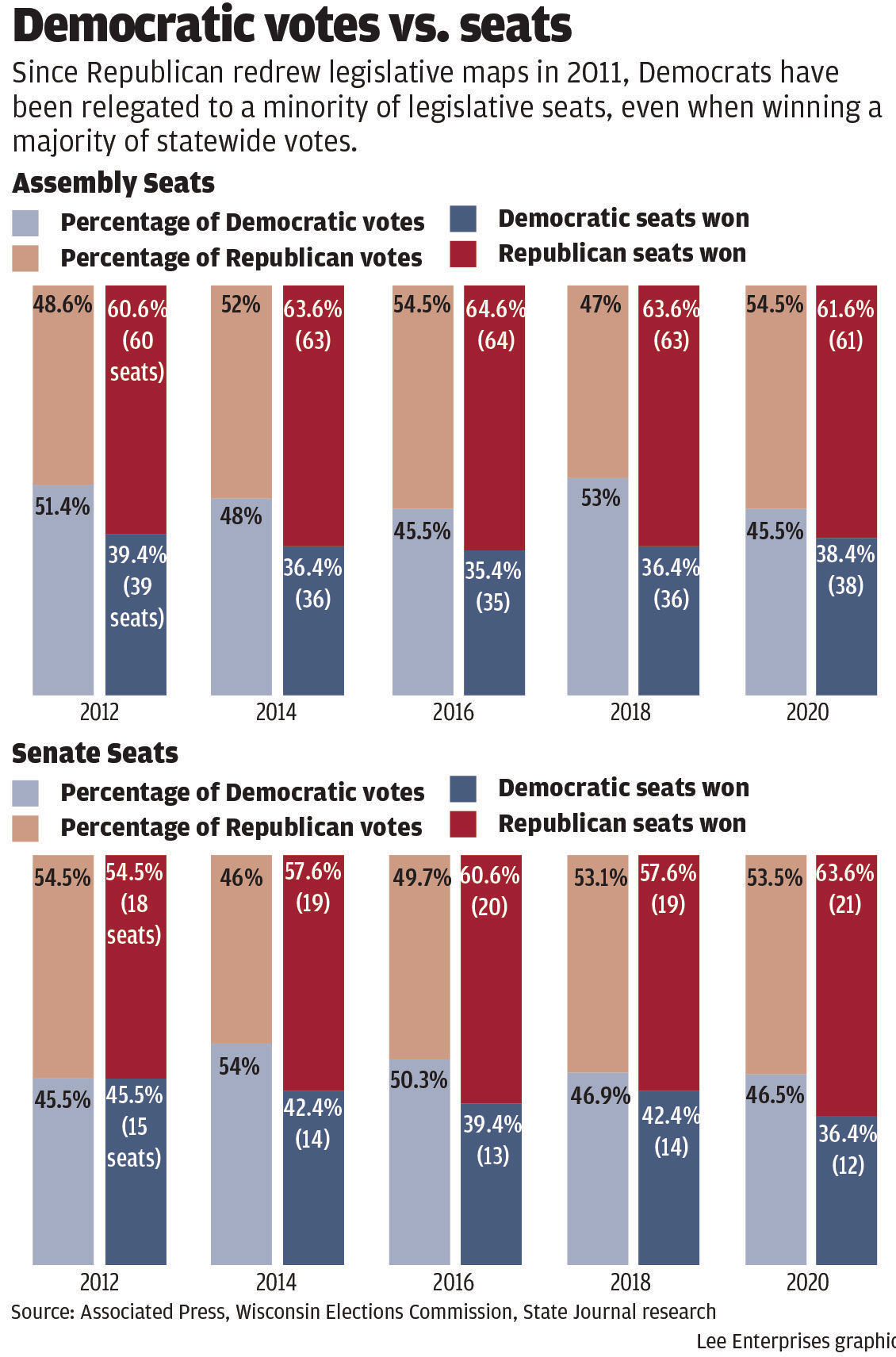
Going into the 2022 election, Wisconsin’s state legislative maps were among the most heavily gerrymandered in the country. Although Democrat Tony Evers won reelection to the governorship by more than 3 percent of the vote, that same election resulted in a legislature just two seats shy of a veto-proof Republican supermajority. This followed a pattern set by the 2010 redistricting cycle, when lawmakers drew maps designed to ensure a Republican majority that would hold for the rest of the decade.
Redistricting matters have been actively litigated in the Wisconsin courts in recent years. In 2021, when the legislature and governor reached an impasse on adopting new maps, the Wisconsin Supreme Court declined to consider partisan fairness when assessing which maps to adopt. Instead, the court directed parties to propose maps that made the “least change” to existing districts necessary to comport with legal requirements, which caused the post-2020 maps to perpetuate the partisan skews of the post-2010 maps.
Then, in 2023, Wisconsin voters elected Justice Janet Protasiewicz, which changed the ideological balance of the court. Addressing a challenge to the 2022 maps, the court sidestepped the issue of partisan gerrymandering but found that the maps violated the constitution’s contiguity requirement and thus needed to be redrawn. The court then held that, contrary to its prior ruling, it should seek to assure partisan neutrality when choosing a map to remedy a violation of other constitutional provisions. At that point, the legislature and governor reached a deal to enact new legally compliant maps, which put an end to the litigation.
Direct Democracy, Home Rule
To amend the Wisconsin Constitution, legislators in two successive legislative sessions must vote, by a majority in both houses, to pass the amendment and present the proposal to voters. This process does not involve gubernatorial approval or veto.
Since 2020, the Wisconsin legislature has referred more amendments (eight over five years) than it did over the prior two decades (when voters considered just eight amendments total). However, that number is far lower than the number of amendments proposed and ratified in the 1960s, 1970s, and 1980s.
Although Wisconsin voters may approve or reject constitutional amendments, they do not have the power to put amendments or statutes directly on the ballot or to reject statutes passed by the legislature. In fact, Wisconsin is one of only three states (alongside Texas and Rhode Island) where voters have had the opportunity to adopt the initiative or referendum power and rejected it. The rejection can be traced back to popular frustration with the legislature after several large tax increases in 1913. The following year’s legislatively referred amendments became an easy target for voters’ anger, with candidates from both major parties denouncing all of the amendments on the ballot rather than explaining that the initiative, referendum, and recall (later adopted in 1926) amendments would give voters the tools to repudiate the very legislative actions they were protesting. Recent comments and proposals from Wisconsin politicians have led to a renewed interest in the initiative and referendum power.
Despite lacking a statewide initiative and referendum power, the Wisconsin Constitution nonetheless promotes other forms of self-governance by granting localities home rule powers, which give these localities the authority to manage their own affairs and governments. Wisconsin’s experiment with home rule began in 1911, when the legislature passed a city and village home rule statute. However, the Wisconsin Supreme Court held that the statute was unconstitutional because the constitution stated that it was the “duty of the legislature . . . to provide for the organization of cities and incorporated villages.” In response, the legislature sought to amend the constitution. Voters rejected the amendment in 1914, but they adopted one in 1924 giving municipalities home rule powers.
Constitutional Interpretation
Wisconsin precedent establishes some basic interpretive principles. For example, the Wisconsin Supreme Court will attempt to read the constitution holistically; will consider what amendments likely meant to ordinary voters; and will undertake a “‘more intense’ review of extrinsic sources” when interpreting the constitution than when interpreting statutes.
Sometimes the court also borrows or incorporates federal court interpretations of similar provisions. But the federal constitution serves as a floor, and the Wisconsin Constitution may provide broader rights than those found in the federal constitution even when the provisions are analogous. For example, the Wisconsin Supreme Court has held that the state constitution’s right to be free from unreasonable search and seizure provides greater protections than the Fourth Amendment in some contexts. It has also applied strict scrutiny to a claim brought under Wisconsin’s free exercise clause, even when federal First Amendment analysis would have subjected the claim to a less burdensome balancing test. This independent interpretation is a practice that began early: In 1859, the Wisconsin Supreme Court held that counties are required to provide (and pay for) attorneys for indigent criminal defendants under the Wisconsin Constitution, 104 years before the U.S. Supreme Court held the same under the federal constitution.
The state supreme court has also needed to strike out on its own when interpreting constitutional provisions that have no federal analog. For example, the court has held that Wisconsin children have a “fundamental right to an equal opportunity for a sound basic education, ” though it has declined to hold that the state’s school finance system, which has produced substantial educational inequality, violates that right. The court has also held that reasonable restrictions on the right to hunt may include prohibiting the taking of any wild bird not expressly authorized by regulation.
To date, the Wisconsin Supreme Court has not followed the trend of the U.S. Supreme Court and some other state high courts in announcing a single interpretive methodology, such as originalism, to the exclusion of others. Instead, the justices continue to debate interpretive approaches for both constitutional and statutory questions, and the court’s current majority appears to favor a pluralistic approach.
• • •
Wisconsin’s founding charter continues to serve as a rough guide for the state’s governance. Its original text and amendments form a set of provisions, old and new, that reflect input from legislators and voters alike. Although inevitably imperfect, the constitution offers resources for residents and officials who want to safeguard the state’s aims of individual and collective self-determination — and lead the state according to its motto: “Forward.”
Miriam Seifter is the Richard E. Johnson Bascom Professor of Law, H.I. Romnes Fellow, and co-director of the State Democracy Research Initiative at the University of Wisconsin Law School.
Emily Lau is a staff attorney with the State Democracy Research Initiative at the University of Wisconsin Law School.
Suggested Citation: Miriam Seifter & Emily Lau, The Wisconsin Constitution: Initial Adoption Fights and a Veto Power That’s Still Contested, Sᴛᴀᴛᴇ Cᴏᴜʀᴛ Rᴇᴘᴏʀᴛ (June 26, 2026), https://statecourtreport.org/our-work/analysis-opinion/wisconsin-constitution-initial-adoption-fights-and-veto-power-thats-still

Related Commentary
What This Year's U.S. Supreme Court Term Means for State Courts
The Court’s decisions on religious liberties, transgender rights, gun restrictions, and more have significant implications for state lawmakers, courts, and constitutions.
Hemani Is Not the End of Drug-and-Gun Litigation
The U.S. Supreme Court’s decision that it was unconstitutional to disarm a person based on regular marijuana use contains lessons for state judges, policymakers, and litigants.
The Many Versions of State Constitutional Lockstepping
The practice of interpreting state constitutions identically to their federal counterpart is often criticized in blanket terms. But the ways state courts lockstep vary widely.
Texas Parental Rights Amendment Threatens to Invalidate Child Abuse Laws
During oral arguments in a child abuse case, some Texas Supreme Court justices seemed open to the possibility that the amendment protected parental violence against children.